Afterword: Sunday Buri Masal
Every Sunday, breakfast was Buri Masal. Not puri masala, thank you very much.
It wasn't particularly elaborate, but it was a production, and everyone had a job. Amma boiled the potatoes. Appa peeled them. My sister cut the onions. Amma slit the green chillies, chopped the ginger, and got the tempering going. Mustard seeds, a couple of dals, plenty of curry leaves. The potatoes went in, along with some water, and the whole thing became a gravy.
There was no tomato, no garlic, no elaborate masala. Just potatoes, onions, green chillies, ginger, and the usual suspects. Served piping hot, with freshly made puris.
Amma made the puris, of course. And because she was Amma, she would roll out every last bit of dough, even when everyone had eaten enough. Which meant there were sometimes extra puris.
These went into a large bowl with milk and sugar, where they were left to soak before being put in the fridge. The next day, or sometimes the day after, we had what was essentially cold, sweet, soggy puris for dessert or breakfast.
It sounds deeply unappetising when I describe it like that. We loved it.
Our breakfast repertoire was otherwise quite extensive. Idlis, dosas, uthappams, pesarattus, adais, upmas of every conceivable kind, poha, and all the other things that made their way into Amma's weekly rotation. Most of it was reasonably healthy, or at least gave the impression of being so.
Buri Masal was probably the least healthy breakfast of the week. Which, naturally, made it the most exciting.
We still love it.
Now
Amma managed all of this in her head.
Not just Sunday breakfast, but every meal, every day. The shopping, the planning, the substitutions, the calculations about what was left in the fridge and what needed to be used up. She did it all without a meal planner, a spreadsheet, or an app. I don't remember her ever sitting down to work out what we were going to eat for the week. Somehow, she just knew.
Today, it takes my sister-in-law Vinothini and me to do what Amma did by herself.
We started with handwritten meal plans. Eventually, we graduated to a Notes app shared across the family. Every now and then, a notification pops up telling me that Vinothini has edited something.
I open the note. She's changed Thursday's menu.
I immediately WhatsApp her.
"Hey, why did you switch that out?"
"I found really fresh palak today."
Fair enough.
Meanwhile, my brother keeps asking, "Shall we do the meal planning? Shall we do the meal planning?" He has opinions. Many opinions. My nieces, when they're home from college, have opinions too.
So the planning continues to be a communal affair, involving several people, multiple devices, and the occasional negotiation over palak.
Amma did it all in her head.
There's a line in The Lunchbox that has stayed with me. Saajan Fernandes says, "I think we forget things if we have no one to tell them to."
I don't know that I speak about my mother every day. In fact, I'm fairly certain I don't.
But she is still running our kitchen from the afterlife.
She's there when I reach for jaggery instead of sugar. When I decide something needs gingelly oil. When I turn off the stove, close the lid, and let whatever is in the pan finish cooking in the heat that's left.
I don't think about these things very much. I just do them.
Which is perhaps the strangest thing about losing someone. You can go days without speaking about them, and yet find yourself doing things exactly the way they would have done them.
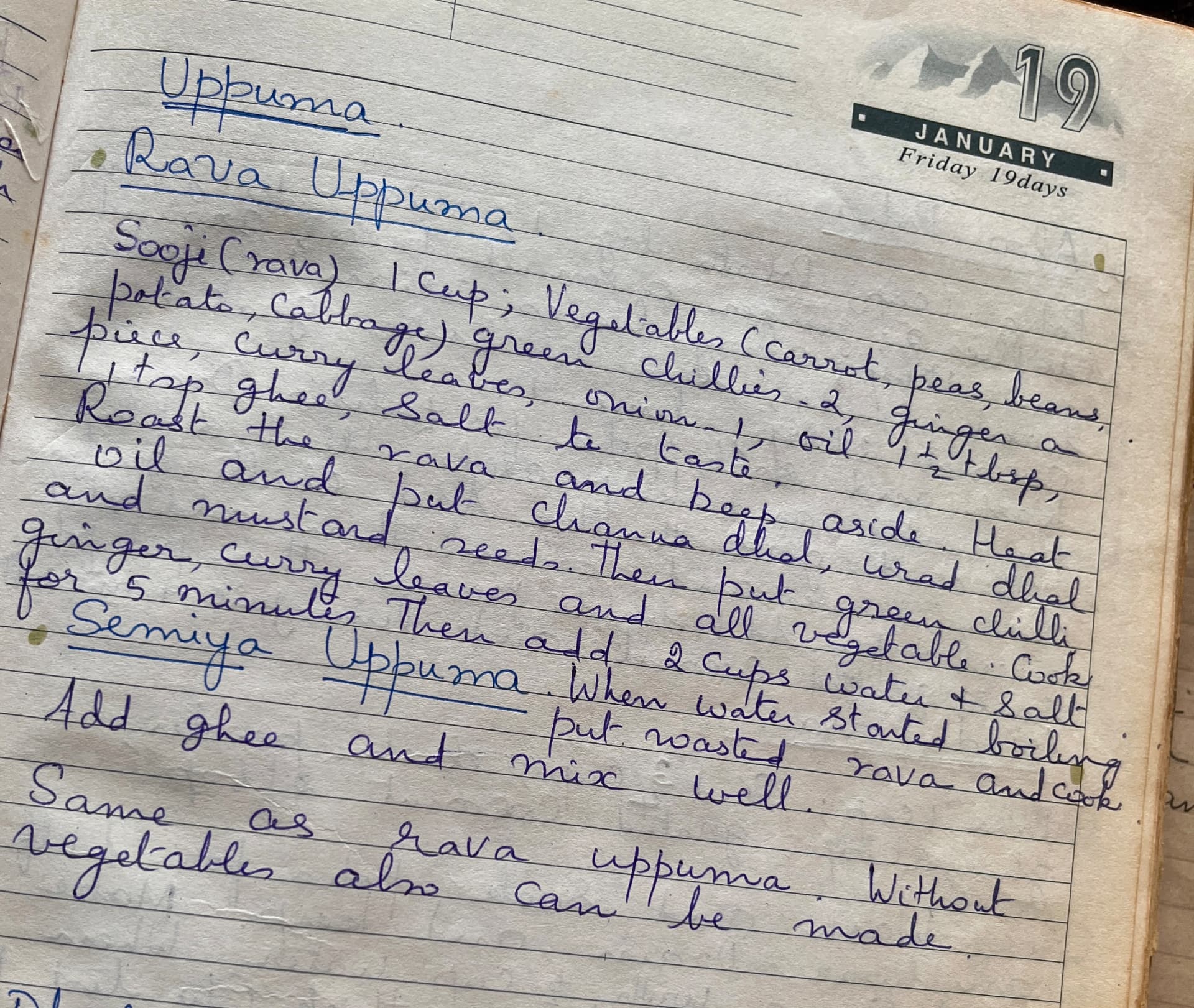
Amma left behind notebooks full of recipes. But she also left behind an entire way of thinking about food, and somehow, without either of us noticing, I seem to have acquired it.
I started this book because I didn't want us to forget her recipes.
Somewhere along the way, I realised I was writing about all the ways we haven't forgotten her.