Foreword
For Amma, Who Measured Love in Ladles
Every family has its archive. Ours lived in a ruled notebook with a faux-leather cover, faintly stained with turmeric, the occasional oily thumbprint, and a corner that refused to lie flat.
It was Amma's recipe diary.
It wasn't particularly precious, at least not in the way we think of precious things. It wasn't displayed on a shelf or wrapped carefully in plastic. It lived in a drawer near the kitchen phone, alongside all the other things that needed to be kept somewhere.
Amma didn't really need it. Most of the time, she cooked from memory. She knew how much mustard to throw into hot oil, how much water something needed, and when a dish was done, often without looking at a clock. The diary was where she wrote things down, particularly the recipes she wanted to remember, the ones she'd learned from someone else, or the ones that required a little more precision than her usual handful of this and pinch of that.
Growing up, I had very little interest in any of this.
I was interested in eating, certainly. But not necessarily what was being served.
Our house ran on a fairly predictable breakfast schedule. There were idlis, dosas, uthappams, pesarattus, adais, and a bewildering number of things that could be made from rava. Some I loved. Others I tolerated. And then there was upma.
Upma and I had a difficult relationship.
I considered it a personal affront. Amma considered it breakfast. We were both fairly committed to our positions.
Of course, Amma had the considerable advantage of being the person who actually made breakfast, so you can imagine how most of these negotiations ended.
And now, several decades later, I find myself voluntarily making upma.
Not because I've run out of options. Not because someone has insisted that it's good for me. But because, every now and then, I actually want to eat it.
I don't know when this happened. At some point, the dish I once regarded as a punishment became something I associated with home. Perhaps it's the smell of rava roasting in ghee, or the sound of mustard seeds spluttering, or simply the fact that nobody makes it quite like Amma did.
I still wonder whether she'd approve of my version. Probably not entirely. There would almost certainly be something I could have roasted a little longer, stirred a little better, or taken off the stove a minute earlier.
But I suspect she'd be pleased that I was making it at all.
When I began going through her recipe diaries, I realised how much was in them. Not just the everyday food we grew up eating, but sweets, snacks, festival dishes, recipes collected from friends and neighbours, and things she had clearly made once, liked, and decided were worth writing down.
Some instructions were wonderfully precise. Others assumed a level of culinary understanding that I clearly hadn't inherited. A pinch of this. A little of that. Cook until done.
Done according to whom, Amma?
There were recipes I remembered immediately, and others I'd almost forgotten. Some brought back entire afternoons. Others reminded me of people who had sat at our table, or of festivals when the kitchen seemed to operate continuously for days.
And slowly, what began as an attempt to put her recipes together became something else.
I started remembering the routines around the food. The dishes we looked forward to, the ones we complained about, the things Amma made because somebody was visiting, and the small accommodations she made for everyone's preferences.
There was a surprising amount of negotiation involved in feeding our family. Amma was remarkably good at it, although she didn't always believe that our opinions deserved equal consideration.
This book is not an attempt to reproduce her cooking perfectly. I don't think that's possible. For one thing, she isn't here to tell me what I've done wrong.
Instead, I've tried to preserve the recipes as she made them, along with the stories that came back to me as I worked through her notebooks. I've kept her notes wherever I could, including some of the instructions that make perfect sense if you already know what you're doing and rather less sense if you don't.
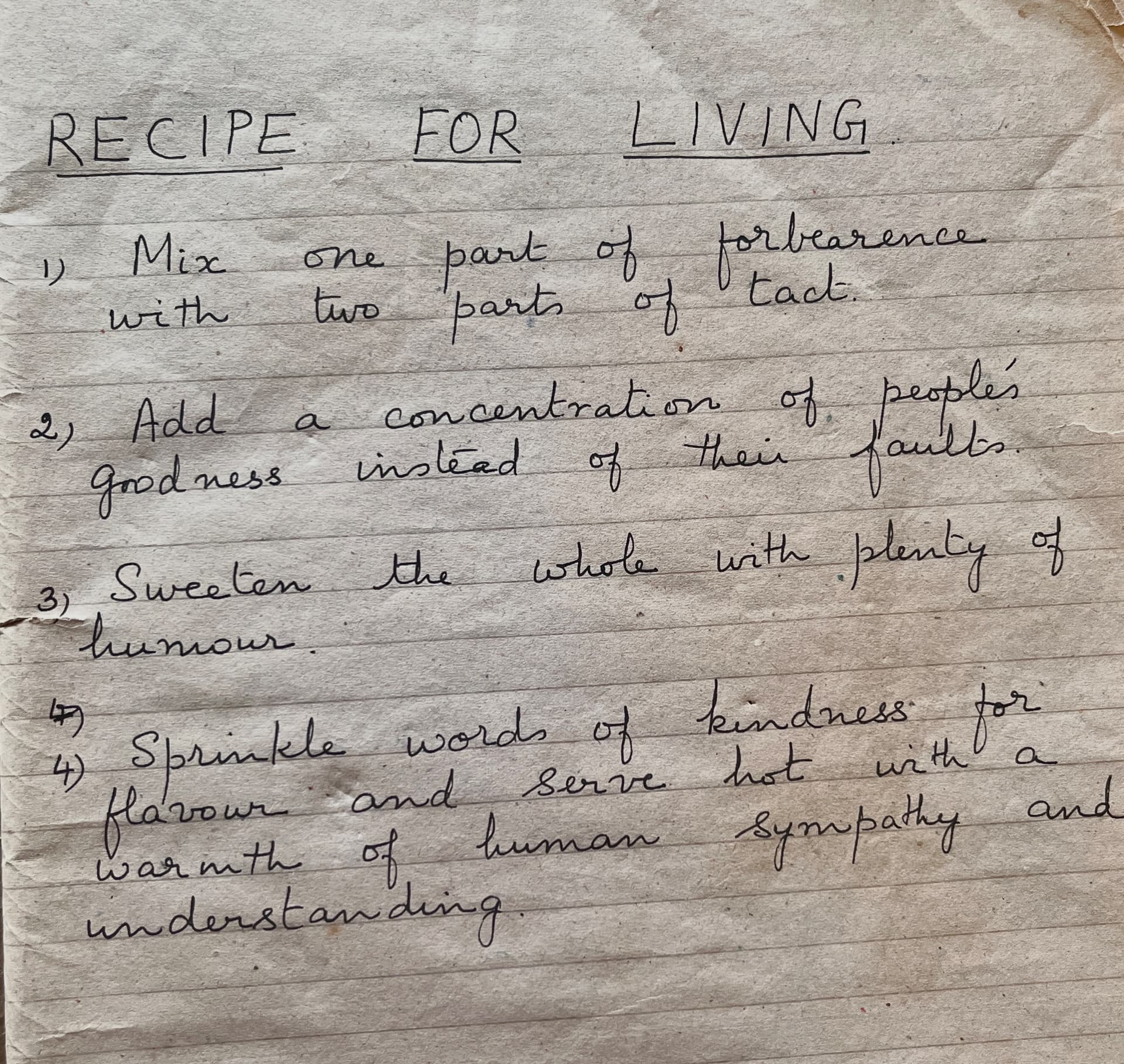
I've also kept some of her handwriting, because there is something about seeing a familiar hand on a page that no neatly typeset recipe can quite replace.
These are not restaurant recipes. They were never intended to be. They are the food of our everyday lives, of festivals and visitors, of hungry children and unexpected guests, of things made in a hurry and things that took an entire afternoon.
And occasionally, of things we were made to eat despite our very reasonable objections.
I hope you'll find something here that you remember. A dish you haven't eaten in years, a taste you thought you'd forgotten, or perhaps a recipe you've been meaning to ask someone for.
And if you find yourself making Amma's upma, I hope it turns out exactly as she would have wanted.
Although, knowing Amma, she'd probably have a suggestion or two.